
Canine Cataracts

Cataracts are one of the most common causes of blindness in dogs. The normally black pupil turns white as the lens that sits right behind the iris becomes opaque.
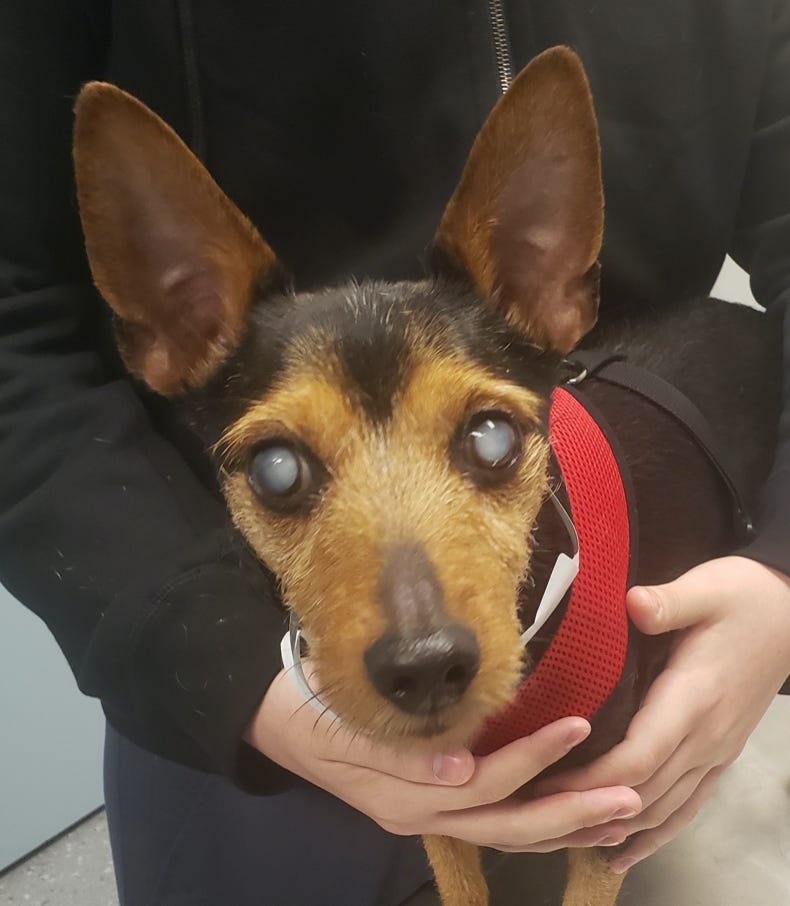
The cataract obstructs normal light transmission to the retina — the back of the eye that transmits optics to the brain — resulting in blindness.
Causes of cataracts
Genetics plays a role in some purebred dogs (Afghan hound, bichon frise, Boston terrier, Chesapeake Bay retriever, golden retriever, Labrador retriever, Australian shepherd, cocker spaniel, Siberian husky, poodle, German Shepherd). Prior to being used for breeding, dogs should be screened for cataracts by a board certified veterinary ophthalmologist.
Diabetes mellitus is a common cause of canine cataracts. Excess glucose within the eye is converted into sorbitol which then pulls excess water into the lens. This disrupts lens clarity and causes cataract formation. Approximately 75% of diabetic dogs develop cataracts.
Other causes of cataracts include trauma, inflammation within the eye, displacement of the lens, and age relate changes.
Treatment
Just as in people, lens replacement surgery in dogs restores vision. After making incisions in the cornea and the lens capsule, high-frequency vibration (called phacoemulsification) pulverizes the lens material, which is then removed by vacuum. The surgeon inserts an artificial lens, sutures the cornea, and voila, vision is restored! Cataract surgery should only be performed by a specialist in veterinary ophthalmology.
Prior to cataract surgery, the ophthalmologist will perform a test called an ERG (electroretinogram) to make sure the retina works properly. This helps guarantee that the dog will be visual following surgery.
Cataracts tend to produce inflammation within the eye, a condition known as lens-induced uveitis. Anti-inflammatory eyedrops are used to treat this.
Vision loss
Because cataracts develop gradually, most dogs adapt surprisingly well to their vision loss, especially in familiar surroundings. So, no reason to despair if cataract surgery isn’t a feasible option for your dog.
Lenticular sclerosis
A normal aging change in dogs called lenticular sclerosis can mimic cataracts, but does not cause blindness. More on this next week.
Have you ever cared for a dog with cataracts? What was the outcome? Please share your story.
Best wishes to you and your four-legged family members for abundant good health,
Dr. Nancy
This is an interesting subject. As it is treatable I'm sure many pet parents would give it consideration. Do you have any flexible idea of pricing?