
Leaky Dogs
A Primer on Urinary Incontinence

Does your dog wake in the morning in a puddle of pee? Does she dribble urine when up and about, even if she went outside not long ago? Medically speaking, this involuntary leakage is called urinary incontinence.
Not only can incontinence be bothersome and even embarrassing (dare I anthropomorphize) for the dog, it’s a cleanup nightmare, resulting in frustrated attempts to use diapers, load after load of laundry, and irrational reprimands. Worst-case scenario, the dog is banished to the backyard.
The good news is, most dogs with urinary incontinence respond well to treatment. First, your veterinarian must establish the cause of the incontinence.
Normal urination
When urine travels from the bladder (its holding reservoir) to the outside world, it passes through a narrow tube called the urethra. A muscular sphincter where the urethra connects with the bladder prevents urine leakage by remaining tightly closed until the brain sends a signal that it’s time to urinate. The bladder then contracts at the same time the sphincter relaxes, thus allowing urine to flow. Pretty cool system, eh?
Hormone responsive urinary incontinence
Veterinarians refer to the most common cause of canine incontinence as hormone-responsive incontinence, estrogen-responsive urinary incontinence, and urethral sphincter mechanism incompetence (USMI).
Studies have shown that spaying before 6 months of age increases the likelihood of urinary incontinence later in life. The overall incidence in spayed females is 3-5% and up to 15% in particular breeds: Old English sheepdog, Doberman pinscher, German shepherd, boxer, Weimaraner, Dalmatian, Rottweiler, collie, and Irish setter.
The diagnosis of USMI is made by ruling out other potential causes, specialized pressure testing within the urethra, and/or response to medication. Most dogs with this form of incontinence respond favorably to medication. The standard two that are tried alone or in combination are diethylstilbestrol (an estrogen product) and phenylpropanolamine (PPA). For dogs that are nonresponsive to medication, options include the injection of bulking collagen around the urethra or placement of an inflatable silicone ring around the urethral sphincter.

Incontinence caused by increased thirst
Dogs who drink more water produce more urine, meaning a bladder that becomes maximally distended, particularly during the night when they are sound asleep. The distention can override the urethral sphincter, resulting in leakage.
The key here is to determine the cause of the increased thirst. Correct this issue and the urine leakage typically resolves. Common causes of increased thirst include kidney disease, liver disease, urinary tract infection, and hormonal imbalances (diabetes mellitus, diabetes insipidus, Cushing’s disease, and Addison’s disease). Certain medications, for example diuretics, corticosteroids, antiseizure medications, also increase thirst.
Urethral sphincter abnormalities
Defects at the level of the urethral sphincter can interfere with its normal function. Such abnormalities can include bladder/urethral stones, prostate gland disease, tumors, and infection. Treatment depends on the diagnosis.
Neurological disease
Normal urine retention and the act of urinating is dependent on a complex set of neurological signals involving the brain, spinal cord, and nerves leading to the bladder and urethral sphincter. Disease within any part of this circuitry can result in urinary incontinence, typically accompanied by other neurological symptoms. Therapy is dependent on the underlying neurological disease.
Plumbing problems
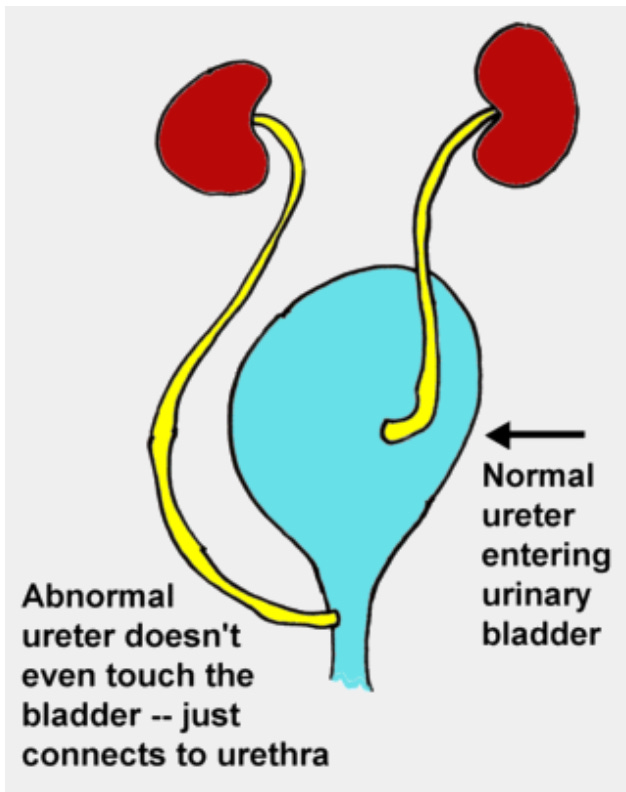
In puppies, the most common cause of urinary incontinence is a birth defect called ectopic ureter. Ureters are the narrow conduits that transport urine from the kidneys to the bladder. The term “ectopic” means in an abnormal place or position, An ectopic ureter tunnels within the bladder wall before opening in an abnormal location or implants directly into the urethra, bypassing the sphincter. The diagnosis of this plumbing defect is made visually either by passing an endoscope (a telescope-like device) into the urethra and bladder and/or by performing an imaging study (CT scan, X-rays) following the administration of contrast material. Treatment involves surgery and/or laser therapy.
What your vet will want to know
If you have a leaky dog, be prepared to answer the following questions for your veterinarian.
When did the incontinence begin?
When is the leakage typically observed—during sleep or with activity, before or after urinating outside?
Have you been filling your dog’s water bowl more than usual? Measure your dog’s 24-hour water intake. The amount should be no more than one ounce per pound of body weight per day.
Does the act of urination appear normal in terms of time spent squatting, strength of urine stream, and appearance and odor of the urine?
Are there any other observed symptoms such as change in appetite or activity level, difficulty passing a bowel movement, or hind end weakness?
Has there been a recent change in diet or addition of a medication or supplement?
Have you ever lived with a leaky dog? What was the diagnosis and what was the outcome?
Best wishes to you and your four-legged family members for abundant good health,
Dr. Nancy
This was such a helpful and informative read. You make a potentially awkward topic approachable, and your compassion for both dogs and their humans really comes through. Grateful for your perspective!
interesting article. I never had a leaky dog, but my female just had spay surgery 2 weeks ago at 4 yrs. I had some concerns prior to her surgery. I adopted her as a re-home from my breeder. She's such a nice girl. She's doing great post-op.