
Urinary Accidents

If your wonderful dog, who has always done his “business” outside, begins leaving puddles in the house, please do not default to the assumption that this is a behavioral issue.
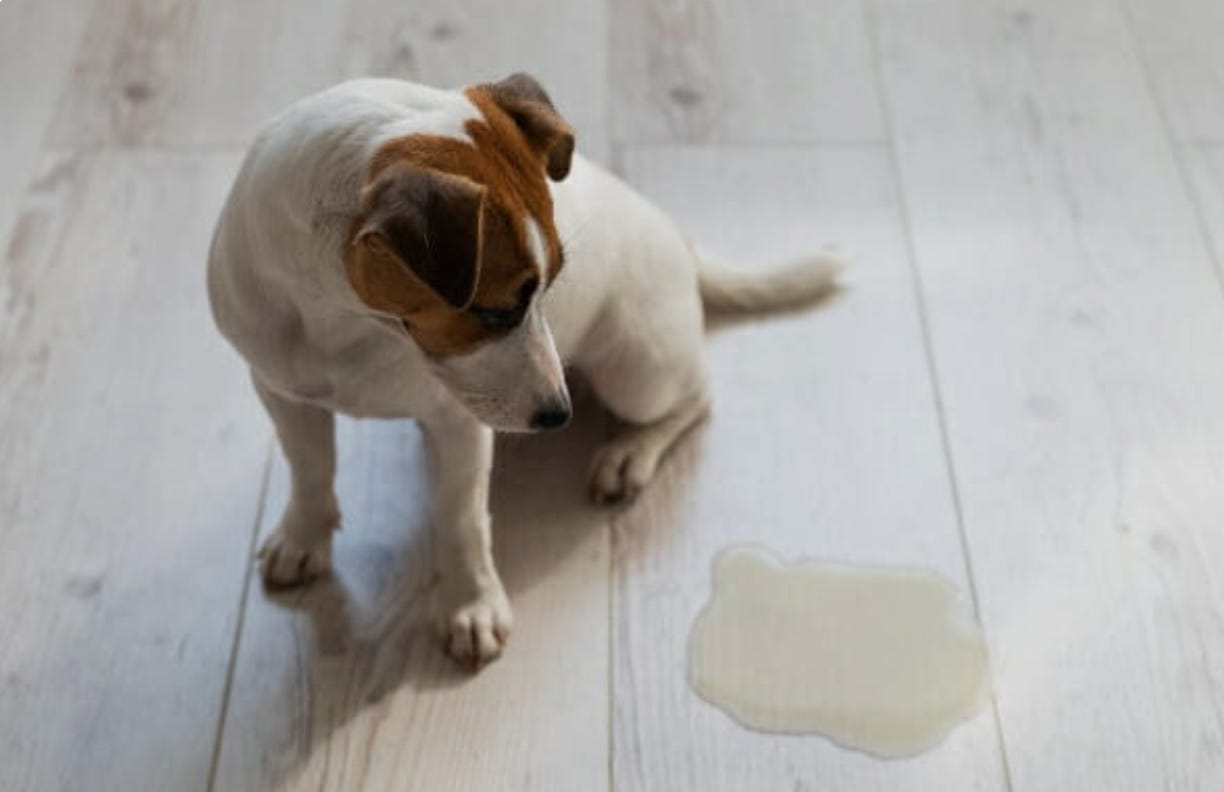
Resist the temptation to think that your dog did this as payback for going somewhere without him or paying too much attention to the neighbor’s dog. Regardless of what they may be feeling, well house-trained dogs would rather urinate anywhere other than inside their own home.
The most likely cause of urinary accidents (inappropriate urination) is an underlying medical issue such as the following:
Bladder infections, stones, and tumors create an urgency to urinate even when the bladder contains only a small amount of urine.
Prostate gland diseases can disrupt normal urinary habits.
Increased water intake may overwhelm a dog’s normal eight to ten-hour bladder capacity. Common causes of increased thirst include hormonal imbalances (diabetes, Cushing’s disease, Addison’s disease), kidney failure, and liver disease.
Commonly prescribed medications such as prednisone (a form of cortisone) and furosemide (a diuretic or “water pill”) typically cause increased thirst, leading to increased urination.
Urinary incontinence
Urinary incontinence (involuntary urine leakage) occurs most commonly in female dogs and can be caused by a variety of underlying medical issues.
The urine leakage may be constant, or only occur during the night when the bladder distends in a sound asleep dog who then wakes up in a puddle of urine.
Fixing the problem
In most cases, correcting the underlying medical issue will fix the inappropriate urination and restore your dog’s house training.
If your dog has a break in house-training, please don’t respond with a reprimand. Far better to schedule a consultation with your veterinarian. After all, isn’t this what your beloved dog deserves?
Has your well house-trained dog ever urinated in the house? Were you able to determine the underlying cause?
Best wishes to you and your four-legged family members for abundant good health,
Dr. Nancy
DrNancyKay.com
My 14-year-old female senior dog started having occasional pee accidents last summer. A vet checkup showed no evidence of bladder infection or other medical causes. We figured it was mainly just from being old; so we started taking her out for a late evening pee break and that seemed to do the trick.
At first, it didn't seem to be working - then we realized that she was just going out and sniffing around the yard and not peeing. I figured maybe she wasn't getting the idea that she was supposed to pee, not just sniff around; so I started going out with her and directed her to a spot in front of our house where dogs walking by always stop and pee. Of course, she wanted to pee there too, and that assured she was "drained" enough to make it through the night.
We never had this problem with our senior male dog, even when he was very old (he lived to be 17), but I guess it's because as a male dog, he LOVED peeing at every possible opportunity. He also was the sort of dog who would go on a 3-mile walk and then come home and poop in the yard. Our female dog has never really liked peeing and pooping in our yard; she has always preferred to do her business outside of our property when she is on her walks. So, I guess the association of "I'm in the yard" with "I should pee" wasn't nearly as strong with her.
I always preach to look for medical reasons first, before jumping to behavioral causes.